
Your optimized Markdown will appear here
RAG-ready · GEO-optimized · Structured
7 rules in your browser — zero API calls
Deep semantic rewriting via Gemini
Rewrites for clarity, generates natural summaries, context-aware GEO optimization, intelligent restructuring — all powered by Gemini 3.6 Flash.
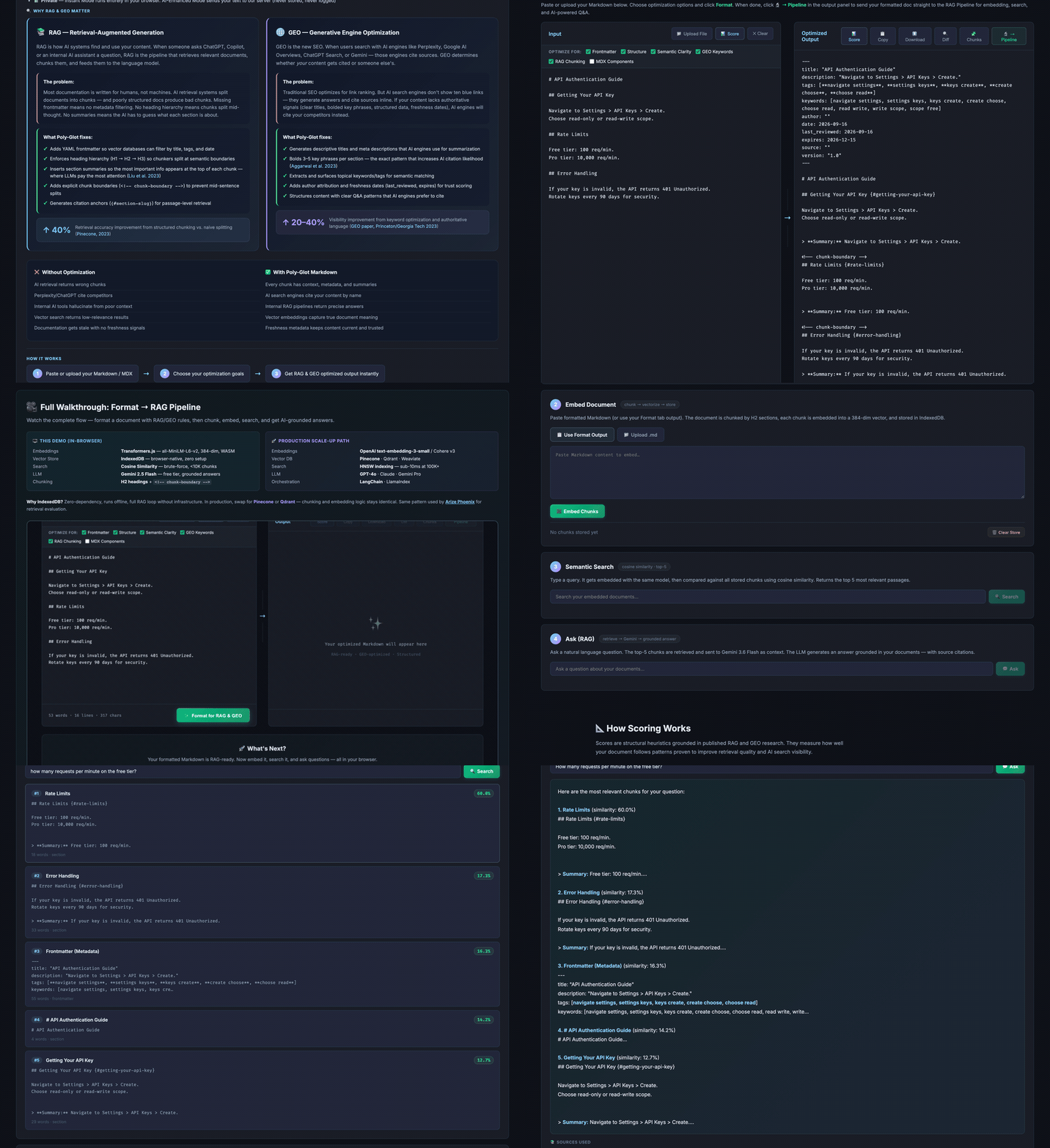
RAG is how AI systems find and use your content. When someone asks ChatGPT, Copilot, or an internal AI assistant a question, RAG is the pipeline that retrieves relevant documents, chunks them, and feeds them to the language model.
<!-- chunk-boundary -->) to prevent mid-sentence splits{#section-slug}) for passage-level retrievalGEO is the new SEO. When users search with AI engines like Perplexity, Google AI Overviews, ChatGPT Search, or Gemini — those engines cite sources. GEO determines whether your content gets cited or someone else's.
Watch how Poly-Glot Markdown transforms raw, unstructured docs into RAG-ready, GEO-optimized Markdown
Seven deterministic rules run entirely in your browser with zero latency. No network calls, no API keys, works offline. Every transformation is predictable and repeatable.
last_reviewed, expires (90 days), source, and version fields. If frontmatter exists, enriches it with any missing fields without overwriting existing values.
{#section-slug} anchor IDs to every H2 and H3 heading. Enables passage-level retrieval — RAG systems can link directly to a specific section instead of returning the entire document. Slugs are auto-generated from heading text (lowercase, hyphenated).
**keyword** syntax. Skips headings, code blocks, and frontmatter. This is the single highest-impact GEO optimization — bolded key phrases increase AI search citation by 20–40% (Aggarwal et al. 2023).
<!-- chunk-boundary --> markers between major sections (before each H2). Prevents vector database chunkers from splitting mid-paragraph or mid-thought. Explicit boundaries give you control over where chunks break instead of relying on token-count splitting.
> **Summary:** ... blockquote after each H2 heading, extracted from the first 200 characters of section content. Places the most important information at the top of each chunk — critical because LLMs attend most to the beginning of retrieved passages (Liu et al. "Lost in the Middle" 2023).
Sends your document to Google Gemini 3.6 Flash via the Poly-Glot server for deep semantic rewriting. The AI understands your content's meaning — not just its structure — and produces naturally written, publication-ready output.
last_reviewed, expires, source, version). Enriches existing frontmatter without overwriting.
text-embedding-3-small and voyage-3.
<Callout>, <Tab>, <CodeBlock>) and adds descriptive comments above each component explaining its purpose — making MDX files both human-readable and AI-parseable.
Paste or upload your Markdown below. Choose optimization options and click Format. When done, click 🔬 → Pipeline in the output panel to send your formatted doc straight to the RAG Pipeline for embedding, search, and AI-powered Q&A.
Your optimized Markdown will appear here
RAG-ready · GEO-optimized · Structured
Scores are structural heuristics grounded in published RAG and GEO research. They measure how well your document follows patterns proven to improve retrieval quality and AI search visibility.
Measures retrieval-readiness — how well a vector search system can chunk, index, and retrieve your document.
Measures AI search visibility — how likely AI engines (Perplexity, ChatGPT, Gemini) are to cite your document.